Our History
For more than eight decades, the World Affairs Council of New Orleans has connected the city to the wider world. Its story begins in 1944, when plans were announced for a New Orleans branch of the national Foreign Policy Association.
In the years since, the organization has grown alongside the city and the shifting currents of international affairs. Through decades of development and several name changes, WACNO’s purpose has remained constant: to foster global understanding through education, dialogue, and active civic engagement.
1944 — The Founding
The World Affairs Council of New Orleans traces its origins to 1944, during the Second World War, when plans were announced for a New Orleans branch of the Foreign Policy Association.
Its creation reflected a national turn toward postwar internationalism—a determination that the United States would help shape the peace rather than retreat into isolationism after the First World War. Locally, it reflected the ambitions of a port city intent on making its global role permanent.
The Council took shape alongside New Orleans’ growing trade institutions. Founding chairman Walter Parker, a veteran civic and commercial leader associated with the port and the Association of Commerce, described the new branch’s purpose as public enlightenment: giving citizens reliable information with which to understand and help shape the nation’s foreign policy.
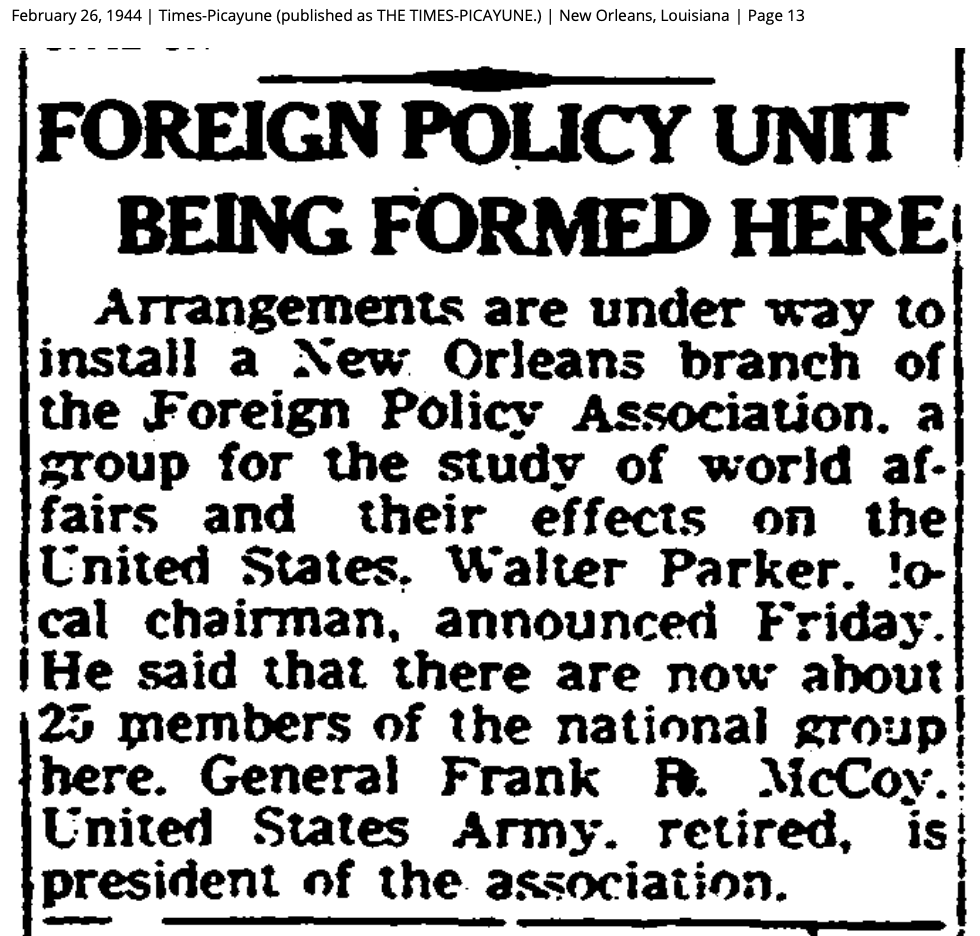
Times-Picayune clipping announcing plans for a New Orleans branch of the Foreign Policy Association in 1944. (The Times-Picayune, February 26, 1944.)
1954 — Postwar Years
In the postwar years, the organization grew beyond its wartime beginnings and took on a more permanent shape. In 1954, it filed for legal incorporation under Louisiana law and expanded its board of directors so it could serve the community more fully and build a more ambitious program.
A new slate of officers led the organization into this chapter: Pendleton E. Lehde as chairman of the board, William T. Walshe as president, and Rear Admiral K. D. Ringle, USN (Ret.), as executive director.
Even as it grew, the association reaffirmed its identity as a nonpartisan, nonprofit forum dedicated to informing the community rather than advocating a political position. Its programming addressed the defining questions of the era, including postwar reconstruction, emerging international institutions, and America’s expanding engagement abroad.
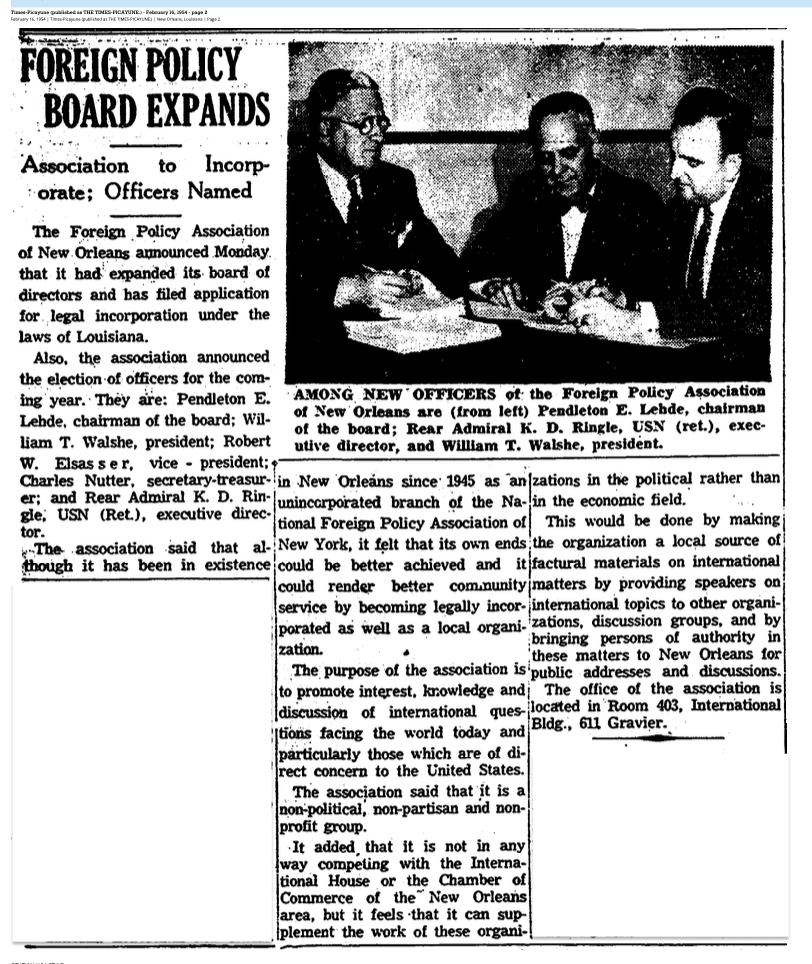
Times-Picayune clipping reporting the expansion and incorporation of the Foreign Policy Association of New Orleans under the Louisiana law in 1954. (The Times-Picayune, February 15, 1954.)
1961 — A Broader Mission
By the early 1960s, the organization had broadened its mission to reflect the changing world. In August 1961, members approved the name Foreign Relations Association of New Orleans.
President Neville Levy explained that the new name reflected a wider scope. The association’s work now reached beyond American foreign policy to international political, economic, and social questions.
Its programs carried New Orleans audiences from the tensions of the Cold War to the diplomacy of alliances and trade, the promise of the space age, and the city’s enduring ties to Latin America. Through these years, the organization held to its founding conviction that an informed public was essential to America’s role in the world.
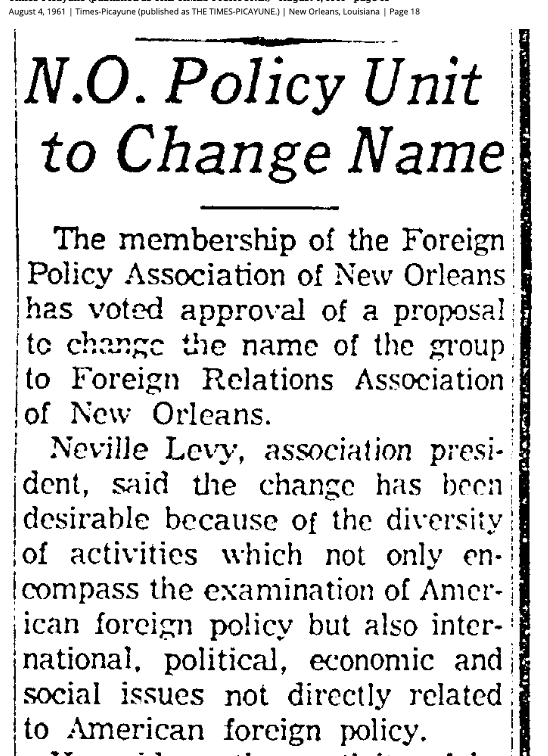
Times-Picayune clipping announcing the organization’s change the name to the Foreign Relations Association of New Orleans in 1961. (The Times-Picayune, August 4, 1961.)
The 1980’s and the 1990’s
The late twentieth century brought profound changes in global trade, technology, and geopolitics. The association broadened its programming and audience to meet them, presenting events on world trade, the closing decades of the Cold War, human rights, and the changing balance among the world’s economies.
Ambassadors, consuls general, scholars, civic leaders, and foreign correspondents brought international perspectives to New Orleans audiences. At a 1987 event, Port of New Orleans director Ron Brinson discussed the country’s place in the new world economic picture—a fitting subject for an organization born from a port city’s global ambitions.
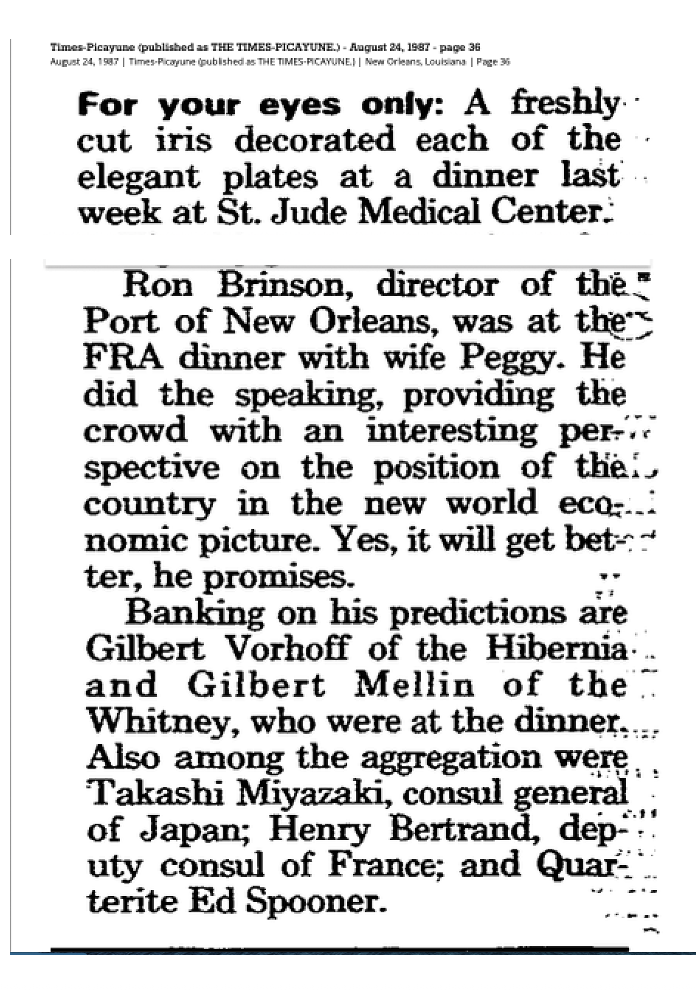
Times-Picayune clipping about Port of New Orleans director Ron Brinson speaking at a Foreign Relations Association dinner in 1987. (The Times-Picayune, August 24, 1987.)
Entering the Twenty-First Century
The attacks of September 11, 2001 reshaped global discourse and America’s role in the world. The Council became a forum for examining international security, counterterrorism, diplomacy, and the balance between safety and civil liberties.
By 2003, the organization was operating under its current name, the World Affairs Council of New Orleans, and was part of the national network of World Affairs Councils. The name reflected its ambition to bring the wider world within reach of New Orleans and the Gulf South.
That ambition was tested when Hurricane Katrina struck in 2005. WACNO’s international ties became channels of solidarity: France supported the city’s cultural recovery, South Korea and Taiwan contributed to rebuilding efforts, and scholars from Kyoto shared lessons from the Kobe earthquake. In the aftermath of catastrophe, the Council found renewed meaning in an old truth—no nation, city, or recovery stands alone.
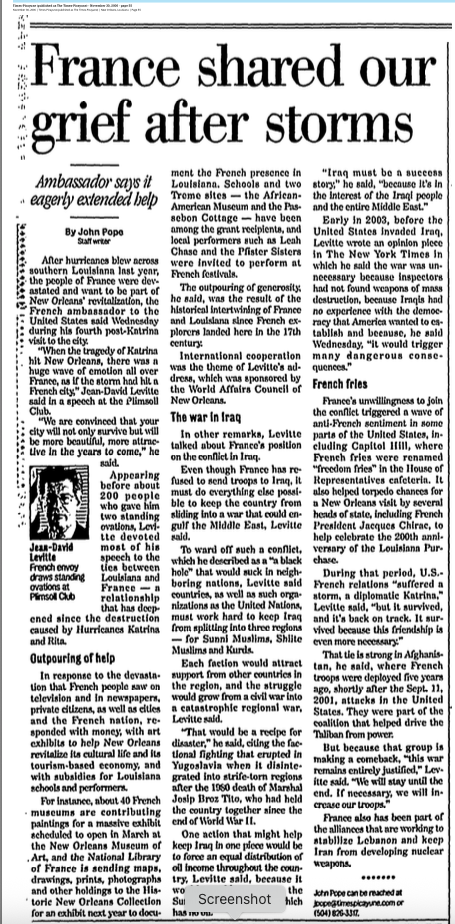
Times-Picayune article about France’s support for New Orleans after Hurricanes Katrina and Rita. (Times-Picayune, November 30, 2006.)
The Covid-19 Pandemic
The COVID-19 pandemic disrupted international travel and in-person convening worldwide. WACNO responded by moving programs online while sustaining its mission during a period of global uncertainty..
The programming reflected questions the pandemic brought to the surface. In June 2020, the Council presented Healthcare Systems: The U.S. Versus the World, featuring Dr. W. J. “Dub” Lane of the University of New Orleans.
In August 2020, a Great Decisions session examined misinformation and conspiracy theories during a pandemic. Ambassador Daniel Fried (Ret.) of the Atlantic Council and Voice of America journalist Margo Gontar, co-founder of the Ukrainian fact-checking project StopFake, discussed propaganda techniques and the ways misinformation travels across borders.
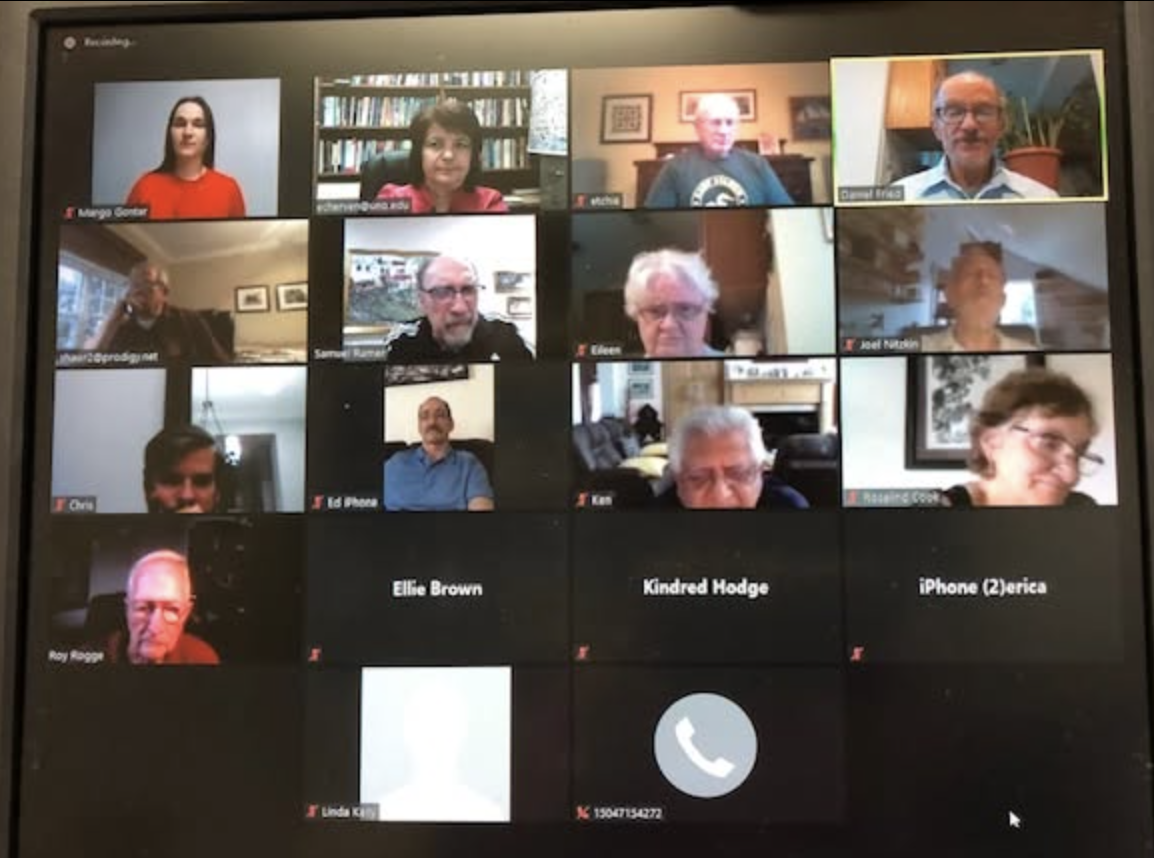
Screenshot from WACNO’s Great Decisions program on disinformation during the COVID-19 pandemic, held online on August 12, 2020. (WACNO Archives.)
Today
More than eighty years on, the World Affairs Council of New Orleans continues this tradition by fostering global understanding and encouraging meaningful international dialogue.
Through speakers, educational programs, and community events, WACNO connects people in New Orleans with perspectives from around the world and creates opportunities to explore the global issues shaping our shared future.
Now more than ever, the mission matters: to broaden horizons, deepen cross-cultural understanding, and strengthen our community’s connection to the world.
The World Affairs Council of New Orleans (WACNO) is a proud member of the World Affairs Councils of America (WACA)
WACA serves as the national office for the network of more than 90 member organizations in 40 states working to engage and educate Americans across the country about global affairs and foreign policy.
WACA traces its earliest roots to 1918 when the League of Free Nations Association was formed to support President Woodrow Wilson’s efforts to achieve a just peace. The founding members, among them John Foster Dulles and Eleanor Roosevelt, worked to promote awareness of critical international issues affecting the U.S., and nurture grassroots citizen involvement in international affairs. By 1947, the group operated as a national organization that was composed of a network of independent community councils. In 1986, the National Council of World Affairs Organizations national office was established in Washington, D.C. This office evolved into the World Affairs Councils of America.
